Run·Road
Wroclaw
Biegi Wrocław
Listed in our event index as Biegi Wrocław 2026.
 © OpenStreetMap
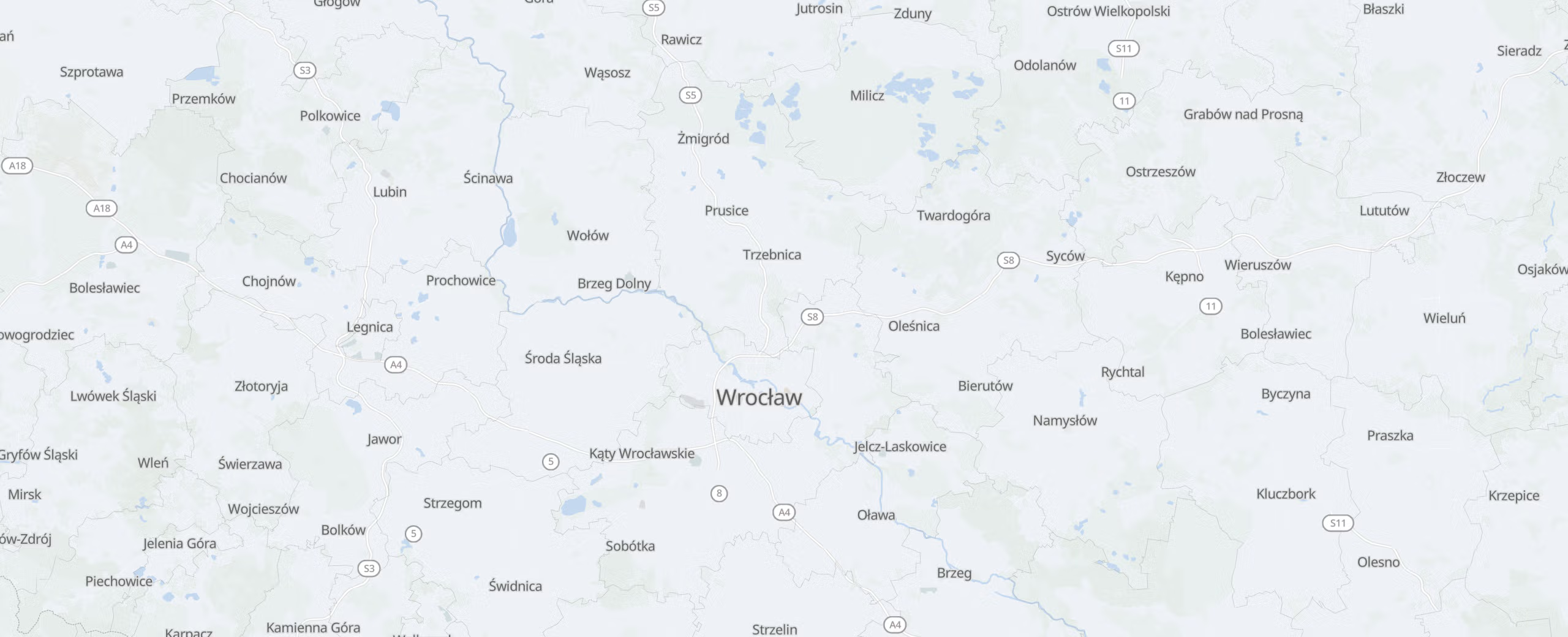
Wroclaw
Częstochowa159
Poznań136
Pardubice273
Gliwice235
Liberec195
Opole131
Wałbrzych93
View all 278 events on map
© OpenStreetMap
Wroclaw
Częstochowa159
Poznań136
Pardubice273
Gliwice235
Liberec195
Opole131
Wałbrzych93
View all 278 events on map
Road, trail, gravel, MTB — you name it, we've got it. Find something worth telling your friends about.
With over 85,000 events in 2026, we have the largest endurance event database on the planet — built to be the fastest way to find a race near you.
Listed in our event index as Biegi Wrocław 2026.
The Tour of Małopolska is a professional men’s road cycling stage race held annually in Lesser Poland, the region surrounding Kraków in southern Poland. Known locally as Małopolski Wyścig Górski, or the Tour of Lesser Poland in English, it has been a fixture on the UCI Europe Tour since 2005. This race, first contested in 1961 with a brief interruption in the early 1990s, stands as one of Poland’s longest-running cycling events. The competition typically spans three or four stages, preceded by a prologue, which is frequently staged in Kraków’s Main Market Square and contributes to the general classification. The parcours predominantly features hilly or mountainous terrain, favoring cyclists adept at navigating consistent ascents and varied landscapes over flat sprints. In recent years, the initial road stage has often followed the Alwernia to Trzebinia course. Gazeta Krakowska is the organizing body, and Zbigniew Piątek holds the record for most victories with three overall wins.
Triathlon Wrocław sends athletes into the Oder River in the center of Wrocław, then onto city roads in the capital of Lower Silesia. It is a summer triathlon with two race options: 1/4 IM, made up of a 950 m swim, 45 km bike ride, and 10.5 km run, and 1/8 IM, with a 425 m swim, 22.5 km bike ride, and 5.25 km run. The shorter distance makes the event open to newer triathletes, while the longer one gives experienced age-groupers a fuller day out. The bike course uses main city streets and the bypass, so this is a distinctly urban race rather than a quiet countryside triathlon. The run keeps athletes in view of the city, and the event was created to promote both triathlon and Wrocław itself. Entries are capped, with space for 500 athletes in the 1/8 IM and 1,200 in the 1/4 IM. No competition license is required, participants must be at least 15, and the race also includes side attractions and charity activity around the main competition.
Running: Locals build most running around the Oder River, Stara Odra, Kanal Powodziowy, Ślęza, and the old moat, because the city gives you flat base miles without much fuss. You can run 8 km and 13 km routes that visit Market Square, parks, and waterfront paths. Wyspa Słodowa Park, Park Biskupiński, Szczytnicki Park, and Grabiszynski Park handle easy Z2, while Kanalowa gives dirt underfoot for steadier intervals. Wroclaw Run meets every Saturday from 10:00 AM to 11:30 AM at ulica Strażnicza 4A, and locals use PKO Wrocław Maraton, Wrocław Night Half Marathon 2026, Runmageddon Wrocław, and Wrocławska Dycha Jesien as anchor events.
Cycling: Locals ride Wrocław like a mixed bag of city, rivers, villages, hills, and gravel edges. The Wroclaw Fortress Route gives riders a 54 km loop around the city, and the Oder Trail handles the long-distance routes. EuroVelo 9 starts in northern Wrocław, runs through Pawłowice, Psie Pole, Zacisze, Plac Grunwaldzki, Plac Dominikański, Plac Kościuszki, Plac Powstańców Śląskich, Al. Gen. J. Hallera, and Muchobór Wielki, and then keeps going toward Krzeptów. JustGo loops suit gravel, cyclocross, and base miles from 30 minutes to 4 hours. Towarzystwo Gimnastyczne „Sokół”, Śląsk Wrocław club, and WTS Sparta Wrocław sit in the local club mix. The climbs live around Gajowe Hill, Maślickie Hill, and the Trzebnickie Hills.
Season: September suits marathon rhythm, early June suits PKO Wrocław Maraton, late April suits Bieg Kobiet Zawsze Pier(w)si, and late November suits Wrocławski Bieg Niepodległości z Wąsem. Summer brings warm, sunny training, and thunderstorms can turn a clean Z2 ride or interval session into a quick route call. The city centre runs hotter than the outskirts when the urban heat island kicks in, so locals shift easy miles toward river paths and parks. 5 days per year, so runners and riders keep moving with more layers and steadier efforts.
 Corrida de la BeaujoireNantes, France
Dec 28
run
02
Corrida de la BeaujoireNantes, France
Dec 28
run
02
 Krhanický krosKrhanice, Czech Republic
May 17
run
03
Krhanický krosKrhanice, Czech Republic
May 17
run
03
 The Classic TessenderloTessenderlo, Belgium
Jul 06
run
04
The Classic TessenderloTessenderlo, Belgium
Jul 06
run
04
 1° StraovadaOvada, Italy
May 26
run
05
1° StraovadaOvada, Italy
May 26
run
05
 Trail do SerroteAnadia, Portugal
Mar 14
run
06
Trail do SerroteAnadia, Portugal
Mar 14
run
06
 Skatås sjöar 2026Delsjöbadet, Göteborg, Sweden
Aug 29
run
07
Skatås sjöar 2026Delsjöbadet, Göteborg, Sweden
Aug 29
run
07
 SenderberglaufWindischgarsten, Austria
Oct 03
run
SenderberglaufWindischgarsten, Austria
Oct 03
run